Property Staging in Germany 2026: Complete Agent Guide
Master immobilien staging in the DACH market. Learn how German agents use virtual staging to navigate UWG laws, boost ImmoScout24 conversions, and sell faster.
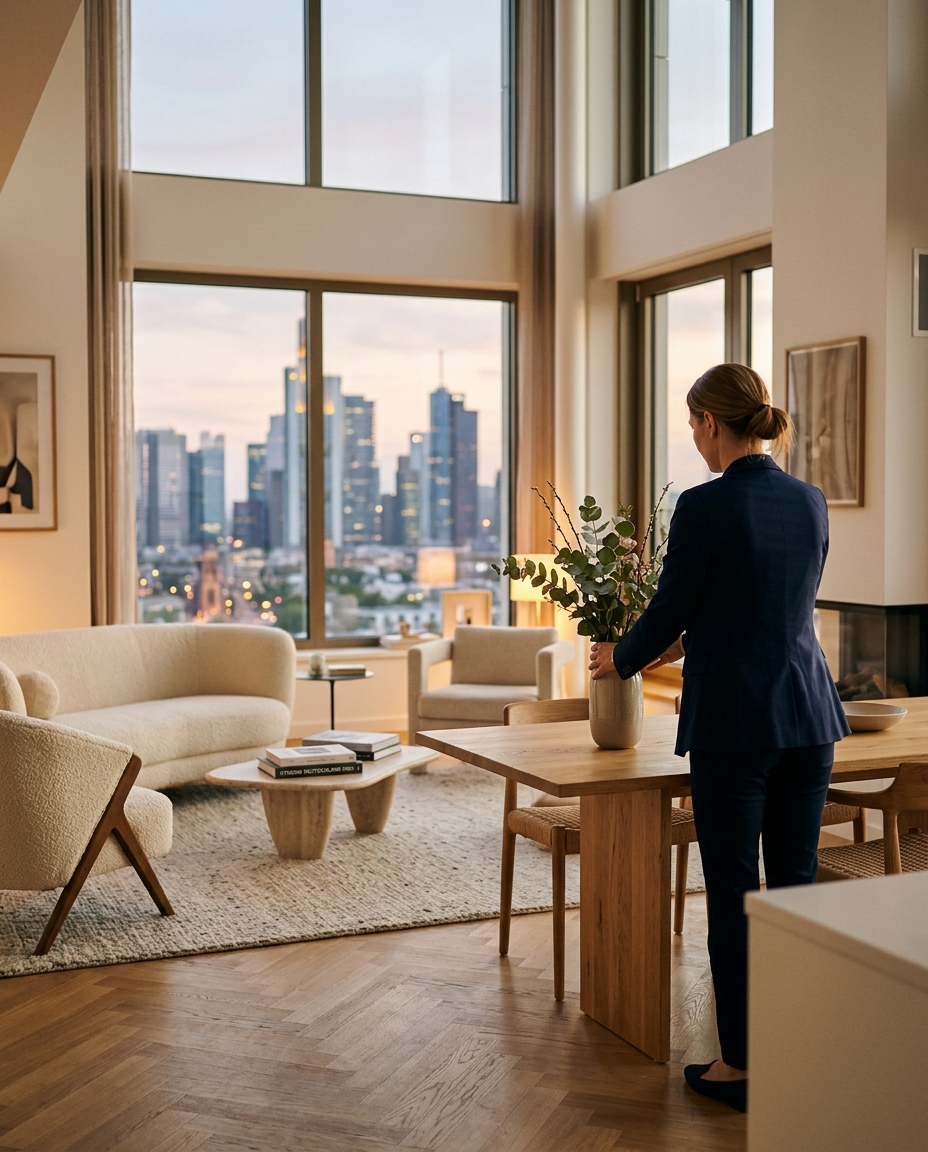
TL;DR: Effectively executing immobilien staging in the DACH region requires navigating strict consumer protection laws (UWG) while meeting high buyer expectations for move-in readiness. Data from ImmoScout24 shows that staged properties generate up to 82% more inquiries, but agents must clearly label virtual interventions to avoid legal liabilities. By leveraging modern AI tools for the first three exposé images, brokers can maximize yield without the prohibitive costs of physical furniture rental.
Data from a recent 2025 ImmoScout24 market analysis reveals a stark reality for DACH-focused agents: listings featuring professionally staged spaces sell 34% faster than vacant properties, even amidst the current interest rate environment. Gone are the days when a clean, empty room was enough to secure a premium valuation in Munich, Vienna, or Zurich. Buyers now expect a clear visual narrative of how a space functions, making property staging not just a marketing add-on, but a core component of fiduciary duty. The challenge for international and local brokers alike is executing this while adhering to strict German marketing laws, managing tighter margins, and ensuring the digital presentation matches the physical reality.The DACH Buyer Expectation Shift
Buyers across Germany, Austria, and Switzerland have fundamentally shifted their baseline expectations over the last 24 months. With tighter lending criteria, purchasers are scrutinizing properties with unparalleled rigor, demanding absolute clarity on spatial dimensions and potential usage. A vacant 15-square-meter room often appears smaller to the untrained eye, causing buyers to question whether it can accommodate a standard double bed and wardrobe. When agents implement proper immobilien staging, they immediately resolve these spatial anxieties, anchoring the buyer's perception in reality rather than doubt.
This shift is particularly pronounced in the urban markets of Berlin and Frankfurt, where yield-focused investors and owner-occupiers alike are heavily influenced by digital-first presentations. The concept of immobilien aufbereiten verkauf (preparing property for sale) has evolved from basic cleaning to comprehensive lifestyle curation. Properties that fail to present a cohesive, modern aesthetic in their digital listings routinely suffer from prolonged days on market (DOM) and subsequent price reductions.
- Over 65% of German millennials begin their property search exclusively on mobile devices, making visual impact within the first two seconds critical.
- Unstaged properties in the DACH region face an average of 2.4 price reductions before securing a buyer, according to internal market intelligence.
- High-end buyers expect sustainability and energy efficiency to be visually communicated through modern staging choices, rather than just listed in the Energieausweis.
Legal Boundaries: UWG and Maklerrecht
Operating in the DACH real estate market requires strict adherence to the Gesetz gegen den unlauteren Wettbewerb (UWG) and specific broker regulations (Maklerrecht). Unlike the less regulated US market, German consumer protection laws heavily penalize deceptive marketing practices. If an agent uses virtual staging to hide physical defects—such as structural cracks or severe water damage—they open themselves up to significant legal liability and commission forfeiture. The core principle is transparency: enhancements must illustrate potential, not obscure reality.
To navigate these regulations safely, any digital alteration must be clearly labeled within the exposé. Watermarking images with "Virtually Staged" or "Einrichtungsbeispiel" (furnishing example) is not just best practice; it is a legal necessity. This ensures that the buyer's expectations are managed before they schedule an on-site viewing, protecting the agent's credibility and shielding the brokerage from claims of misrepresentation.
When acting as a homestaging makler, you must also consider the implications for property valuation. Staging cannot artificially inflate the objective value of the property in official appraisals, but it absolutely influences the subjective willingness of a buyer to meet the asking price. Maintaining this distinction is vital for long-term compliance and client trust.
- Always retain and provide the original, unaltered photos alongside the staged versions in the digital exposé.
- Avoid altering permanent fixtures, window placements, or exterior structural elements during the digital staging process.
- Clearly state in the property description which rooms have been virtually furnished to demonstrate spatial potential.
Physical vs. Virtual Staging Immobilien
The debate between physical furniture rental and virtual interventions has definitively settled in favor of digital solutions for all but the ultra-luxury tier. Physical staging in Germany typically costs between €2,500 and €4,000 for a standard three-bedroom apartment, requiring logistical coordination, insurance, and weeks of lead time. For agents managing mid-market portfolios, these costs severely erode margins and delay the time-to-market.
Conversely, virtual staging immobilien offers an agile, cost-effective alternative that aligns with the rapid pace of modern property marketing. By digitally inserting photorealistic furniture, agents can tailor the aesthetic to specific buyer demographics—shifting from a minimalist Scandinavian look for a young couple to a traditional aesthetic for older downsizers—without incurring additional rental fees. The fidelity of modern rendering has reached a point where buyers cannot distinguish between physical and digital furnishings on a standard smartphone screen.
However, the execution must be flawless. Poorly scaled digital furniture or incorrect lighting shadows will instantly break the illusion, causing buyers to distrust the entire listing. This is where specialized, AI-driven platforms like FramePilot AI outperform generic photo editing services, ensuring precise spatial geometry and lighting integration that meets the exacting standards of DACH buyers.
- Physical staging requires upfront capital and introduces risk of property damage during the move-in/move-out process.
- Virtual staging allows for rapid A/B testing of different interior styles on major portals like ImmoScout24 and Immowelt.
- Digital solutions reduce the carbon footprint associated with transporting heavy furniture across urban centers.
Optimizing the First Three Exposé Images
In the highly competitive German portal ecosystem, the first three images of your exposé dictate your conversion rate. According to engagement metrics from leading European portals, if a buyer does not save the property or click the contact button within viewing the first three photos, the likelihood of an inquiry drops by 90%. Therefore, these initial slots must be ruthlessly optimized, prioritizing the most valuable spaces in the home.
The first image (the hero shot) must immediately establish the property's primary value proposition. For a city apartment, this is typically the open-plan living and dining area; for a suburban house, it might be the master bedroom or the staged rear patio. The second and third images should build a logical spatial narrative, guiding the viewer through the flow of the home. Never waste these premium slots on exterior street views, empty hallways, or poorly lit bathrooms.
When applying staging techniques to these critical images, focus on scale and light. Avoid cluttering the digital space with unnecessary decor items. A well-placed sofa, a rug to anchor the room, and subtle lighting enhancements do more to communicate value than a hyper-detailed, distracting rendering. Keep the focus on the architecture and the potential lifestyle.
- Image 1: The primary living space, staged to show distinct zones for relaxing and dining.
- Image 2: The master bedroom, demonstrating that a large bed and storage can fit comfortably.
- Image 3: The kitchen or a high-value secondary space, such as a home office or staged balcony.
Cost and Turnaround: Virtual Staging Providers
Selecting the right vendor for digital staging is a critical operational decision for modern brokerages. Relying on slow, expensive offshore agencies creates bottlenecks in the listing process, while cheap, low-quality apps damage brand reputation. Agents need a balance of photorealism, speed, and cost-efficiency to maintain a high-velocity pipeline.
The landscape of providers has shifted dramatically with the advent of generative AI. Traditional manual rendering houses are being replaced by hybrid or fully automated platforms that drastically reduce turnaround times. Below is a comparison of standard industry options when evaluating staging solutions for the DACH market.
| Provider | Average Cost per Image | Turnaround Time | Photorealism Quality | Best For |
|---|---|---|---|---|
| BoxBrownie | $24.00 | 24 - 48 Hours | High (Manual) | One-off luxury listings needing custom edits |
| ApplyDesign | $7.00 - $10.00 | 2 - 4 Hours | Medium | Agents willing to manually drag-and-drop furniture |
| FramePilot AI | $1.00 - $3.00 | Under 2 Minutes | High (AI-Native) | High-volume agents needing instant, photorealistic staging |
| Styldod | $16.00 | 24 - 48 Hours | Medium-High | Traditional brokerages preferring manual oversight |
How "Immobilien Aufbereiten Verkauf" Impacts Yield
Ultimately, the objective of any staging effort is to protect and maximize the final transaction value. Properties that sit empty signal desperation to the market, inviting aggressive lowball offers from buyers who perceive the seller as motivated or distressed. By presenting a polished, move-in-ready aesthetic, agents reframe the negotiation from a position of strength.
In the DACH region, where the negotiation culture is direct and data-driven, visual presentation acts as a powerful counterbalance to nitpicking over minor physical flaws. When buyers can vividly picture themselves living in the space, emotional attachment supersedes purely analytical objections. This emotional premium is what drives competitive bidding and secures offers at or above the initial valuation.
Implementing a standardized staging protocol across all your listings—regardless of the price point—elevates your brokerage's brand. Sellers are more likely to grant exclusive mandates (Alleinauftrag) to agents who demonstrate a proactive, modern approach to marketing, ensuring you win more inventory in a constrained market.
- Staged properties command an average price premium of 3% to 5% over comparable vacant listings in the same micro-market.
- A consistent, high-quality digital presence reduces client anxiety and justifies higher commission rates.
- Professional visual presentation significantly increases the likelihood of securing off-market referrals from satisfied sellers.
FAQ
What is immobilien staging?
Immobilien staging is the strategic preparation of a real estate property for sale, using physical or virtual furniture and decor. The goal is to highlight the property's potential, define spatial proportions, and create an emotional connection with buyers, ultimately reducing time on market and protecting the asking price.
Is virtual staging legal for German real estate agents?
Yes, virtual staging is legal in Germany, provided it complies with the UWG (Unfair Competition Act). Agents must not use it to hide physical defects. All digitally altered images must be clearly labeled as "Virtually Staged" or "Einrichtungsbeispiel" to prevent misrepresentation and manage buyer expectations.
How does being a homestaging makler benefit my business?
Acting as a homestaging makler differentiates you from competitors who simply list vacant properties. It allows you to justify exclusive mandates, accelerate the sales cycle, and build a premium brand reputation. Professionally presented listings generate higher inquiry volumes and often secure higher final transaction prices.
What does immobilien aufbereiten verkauf actually involve?
Immobilien aufbereiten verkauf involves cleaning, decluttering, repairing minor defects, and staging the property. In modern practice, this heavily relies on digital preparation: capturing high-quality photography of the cleaned, vacant space and using AI tools to digitally furnish the rooms for online exposés.
Can buyers tell if a property is virtually staged?
With legacy software, virtual staging was obvious due to floating furniture and incorrect shadows. However, modern AI-driven platforms generate photorealistic lighting and accurate spatial scaling. While the images look real, ethical agents always disclose the digital intervention in the listing text and image watermarks.
Scale Your DACH Listings with Intelligent Staging
The data is unequivocal: vacant listings no longer compete effectively in the DACH real estate market. Buyers demand a clear vision of their future home, and agents must deliver that vision without sacrificing operational efficiency or violating marketing regulations. Transitioning from expensive physical staging or slow manual rendering to agile, AI-driven solutions is the most impactful operational upgrade a modern brokerage can make.
Stop losing days on market waiting for offshore editors or wrestling with clunky drag-and-drop software. You need a solution built for the velocity of modern real estate, delivering photorealistic results in minutes rather than days. Upgrade your exposé workflow and start maximizing your listing yields today with FramePilot AI.